The Day I Chased Down Sridhar Vembu
He’s been my inspiration for five years. CogniMuse was built on his philosophy—honestly, half-copied from it. So on 25 February 2025, I did something I’d never done before: I got on a friend’s bike in Sivakasi and rode to Tenkasi to meet him, without an appointment, an address, or any real plan.
If the name doesn’t ring a bell: Sridhar Vembu is the co-founder of Zoho, the software company he grew past a billion dollars in revenue without ever taking a rupee of venture capital. An IIT Madras graduate with a PhD from Princeton, he walked away from a Silicon Valley career at Qualcomm, returned to India in 1996, and co-founded the company that became Zoho—starting out in Chennai. Years later, once Zoho was already a global success, he did something almost no one at his level does: he moved operations into small towns and villages around Tenkasi in rural Tamil Nadu, relocated there himself, and started training local youth who never went to college. He led Zoho as CEO for decades and, just weeks before I went looking for him, had stepped into the role of Chief Scientist to focus on deep R&D. He’s a billionaire—Forbes ranks him and his siblings among India’s richest, with a family net worth around $6 billion—yet he lives simply in that same village and rides a cycle around it. For a bootstrapped founder from a Tier-2 city like me, he isn’t a celebrity CEO. He’s proof that the path I’d chosen could actually work.
Two days earlier I’d messaged everyone I knew at Zoho and everyone who’d worked closely with Sridhar. Nobody replied. (First lesson of the trip: a LinkedIn connection is not a relationship. It means nothing until it does.)
I reached the Zoho office around 9 AM and started in the parking lot, asking employees how I might reach him. Their answers weren’t useful—either they truly didn’t know, or they’d decided I was insane. So I walked straight into the security office and told them I wanted to meet Sridhar.
“Do you have an appointment?”
I didn’t. But I made it clear I wasn’t leaving without meeting him. I was a huge fan and this mattered to me.
Most of the guards claimed they had no idea where he was—Chennai, abroad, who knew. Maybe protocol, maybe the truth. But one of them, seeing how crushed I looked, quietly gave me Sridhar’s email and his PA’s, and told me to send a mail and wait two to four days.
I was heartbroken. Then I thought: even if I have to wait, it’s worth it. The same guard, kind enough to bend the rules a little, gave me Sridhar’s home address and told me to try my luck there. It was about 20 km away.
Standing outside the office, I drafted and sent my first email, explaining exactly why I wanted to meet him. And because fortune favors the bold, I also posted on X that I was right outside his office, hoping to meet him.
Dear Sridhar Anna,
I’m Manoj, an entrepreneur from Karkala, Udupi, Karnataka. I’ve been following you for years, deeply inspired by your journey. I’ve always wanted to meet you, but as you once said, “Nillu, Apram Sollu,” I waited until I had built something meaningful before reaching out.
I see a lot of resemblance in our paths—your philosophy has influenced some of my biggest decisions: choosing not to pursue a master’s degree, bootstrapping my startup to profitability, building from a Tier 2 city in Karnataka, and staying country-conscious in every step I take.
You’ve set a powerful precedent for entrepreneurs like me. It would be a shame if I never had the chance to meet the person who has shaped my thinking. I need guidance on my next steps, and I can’t think of a better guru than you.
I’ve reached out to people at Zoho but haven’t received a response. That won’t stop me. I’m already at the Tenkasi office and now heading toward Govindaperi. Before I lose my internet, I wanted to take one last shot—can I get just 15 minutes of your time today?
I promise not to waste a second. For you, it’s just another meeting. For me, it could change everything and help me create impact at scale for our country.
With kindness, Manoj S
The House
The ride to his house was as scenic as he’d described in his own posts. When I arrived and saw the auto and the cycle he actually rides, I got goosebumps.
The house was guarded, but not the way you’d imagine—there were no black suits, no muscle, and no guns, just middle-aged, average-built locals. Even after I explained why I’d come, they handed me a form: What is the reason for meeting the CEO? plus the usual personal details.
I took almost an hour on it. I refined the wording, highlighted the key points in color—the whole thing. It sounds ridiculous, I know. But I didn’t want to lose my shot because I’d given it 90% instead of 100%.
Same answer as before: His secretary will get back to you.
I couldn’t sit still. I was barely a kilometer from him. Then, about thirty minutes into my wait in the security room, a car pulled out. I leaned in, hoping to see Sridhar. Instead it was Ambi Murthy and Sridhar’s secretary. Ambi was an ex-Zoho employee turned successful entrepreneur—someone I’d followed for months, and funnily enough, one of the people I’d messaged on LinkedIn before coming.
Without thinking, I waved my arm in some frantic way and actually got the car to stop. I introduced myself, told him I knew who he was, reminded him about my message. The secretary explained that Sridhar was flying to the U.S. the next day and I’d have to wait until he returned.
I refused to accept it and kept insisting I wasn’t leaving Tenkasi without meeting him.
Then Ambi asked if I’d eaten. I said no. So he told me to have something inside Sridhar’s house—everyone who comes is fed—and added, “Let’s see if I can do anything.” Then they left.
A kind guard, taking pity on me, slipped me the secretary’s number. With nothing left to do at the house, I rode back to Tenkasi to find a room, putting out another tweet on the way.
I know this stuff is cliché and maybe annoying. But I’m an entrepreneur, and I’m shameless—as I should be. This is the price of getting things done: you have to kill your ego, give it everything, and do whatever it takes.
The Long Night
I booked a room and checked my phone every ten minutes, but nothing came through. The 2.5-hour ride had wrecked me, and I dozed off—only to jolt awake mid-afternoon in something like a mild panic attack. Am I here to sleep or to meet him? That thought ended my nap. I grabbed my phone and fired off a second email.
Dear Sridhar Anna,
I know you’re busy, and I truly respect that. Just wanted to follow up once before I head back tomorrow to Udupi.
I’m still here in Tenkasi, submitted a form at the security gate outside Govindperi guest house, waiting, hoping for a chance to meet you. I wouldn’t persist if this wasn’t important to me. Meeting you isn’t just about a conversation—it’s about learning firsthand from someone who has shaped my thinking in so many ways.
If today isn’t possible, I’d be grateful for any time, even a short window. I promise to keep it sharp, meaningful, and worth your time.
Hoping to hear from you, Anna.
With kindness, Manoj S
Then the silence really set in. There was no reply on email, on X, or on WhatsApp, and none even after I called the secretary and texted him repeatedly. I’d exhausted every option.
When you lose everything, you reach for something higher. I went to the Kasi Vishwanath Temple in Tenkasi and prayed for an hour or two.
As night came, frustration took over. I called a few friends and ranted about India’s entrepreneurship ecosystem—how founders like him are unreachable, yet their social media says otherwise. Maybe they all just say the right things for marketing, I thought, and none of it is real.
(I was wrong, of course.)
I crashed at 3 AM after a couple of late office calls.
Morning
By 9 AM I had woken up, showered, packed, and decided to leave.
Then my phone rang. It was the secretary. He apologized—they’d gotten home late the night before—and jumped straight into a quick interview to understand why I wanted the meeting. Twenty minutes in, he said, “I’ll try my best, but I can’t promise anything. Sridhar is extremely busy.”
Good enough. I dropped my bags and decided to wait. He researched the company, asked more questions, and told me to send my business card on WhatsApp. I sent a third email too.
Dear Sridhar Anna,
I know you must be swamped, and I don’t want to take more of your time than necessary. But before I leave, I wanted to make one last attempt.
I’ve been waiting in Tenkasi, holding onto the hope of getting even a few minutes to meet you—not for a fan moment, but because your journey has shaped many of my decisions. I truly believe this conversation could help me take my next steps in building in rural India.
If it’s not possible this time, I completely understand. But if there’s even a small window, I’d be incredibly grateful. Either way, I’ll keep building, and I hope our paths cross someday.
Thank you, Anna, for everything you’ve unknowingly taught me.
With kindness, Manoj S
Three hours later, my phone rang again.
It was him.
Come to the house at 3:40 PM, he said. The meeting was set for 4:00. I’d have 15 minutes to make my point, so I’d better be crisp.
I got there at 2:00.
The secretary, noticing I wasn’t going anywhere, took pity on me. Instead of leaving me at the gate, he rode his bike over and brought me inside. He saw me furiously writing questions, turned on the fan, and said, “Please continue writing. This is an important moment in your life.” He even offered me coffee while I kept refining. That small kindness meant a lot.
I was hyper-conscious of not wasting a second of Sridhar’s time, iterating and re-ordering my points—
And then came the twist. Sridhar wasn’t coming home after all—he was tied up and wanted me at the office at 4:00 instead. The secretary and I both froze. It was already 3:45, and the office was 20 km away.
There was no choice, so I put every bit of my riding experience to use and rode like a madman, making it before 4:00.
They walked me into a tiny conference room, barely big enough for three people. Then the door opened and he walked in.
I instinctively bent to touch his feet—he was too quick and didn’t notice. (Shit happens.) He looked genuinely tired, and I went blank for a good thirty seconds. I had watched his videos, seen his photos, and read the stories, and now he was sitting right in front of me.
I stammered. He looked at me and said, “It’s okay. Take your time.”
That brought me back.
The Conversation
I introduced myself, explained what I do, and told him how much he’d shaped me—how the company was built on principles I’d learned from him. He was curious, and asked about our offerings, our tech stack, our revenue, our plans to scale.
Then I asked my questions.
How do you build a company with such different types of people—visionaries and non-visionaries who think small?
“First, don’t categorize people as visionary or non-visionary. See them as individuals; each brings different value. You have to work with all types while building a company. Give them a good life without expecting anything in return. If they want to stay with your vision, they will. If not, they’ll leave—there’s no stopping them. Whoever stays, count them as a blessing and keep building. That’s what I did with Zoho.”
How do you evaluate whether a product or service is worth building?
“As a bootstrapped founder, always try to eliminate risk. There are three big ones—market, product, and execution. Market and product risk aren’t controllable, so avoid products that carry them. We built CRMs. Everyone needs a CRM, so market and product risk were gone. We were left with execution risk—and because we executed well, we captured the market.”
Is branding important? I hate branding and want to focus only on the product.
“Branding is a must, but it comes later. Build the product first. If you do it right, branding happens naturally and people come to you.”
I have a grand vision of uplifting underrated talent from tier-2 and tier-3 cities. How do I go about it?
“Sometimes a grand vision is overwhelming. Focus on staying alive in the business while making incremental improvements. You’re bootstrapped, so be careful. Prioritize cash flow. If you’re making 5 lakhs a month, get to 10, then 15. Step by step.”
I’m a tech guy at heart—I hate business, sales, and marketing. You come from tech too but did sales because you had to. How was that?
“Building a product is easy. Identifying a market to sell it in is extremely hard—but you do it anyway. Everyone wants to chase glamorous ideas. But do you know where the real money is? In boring stuff. Nobody wants to do it anymore. Go after a big market willing to pay. Find a niche but burning problem inside a company like Oracle—solve it, and they’ll pay a great amount. Use that to fund your company and grow. I can’t tell you which boring problem to solve; you have to be in the market to find it.”
I’m building an AI platform in the rehabilitation space. What are your thoughts?
“There’s market risk here. People have tried building solutions in healthcare, but accuracy is still unsolved.”
Sometimes I want to build multiple products in parallel. Do you get those thoughts too?
“That’s where founder discipline comes in. Bootstrapped founders have to be disciplined in everything. We can’t keep building multiple things like VC-backed startups. Focus on building one thing successfully before moving to the next.”
I had to stop—I’d already taken up so much of his time.
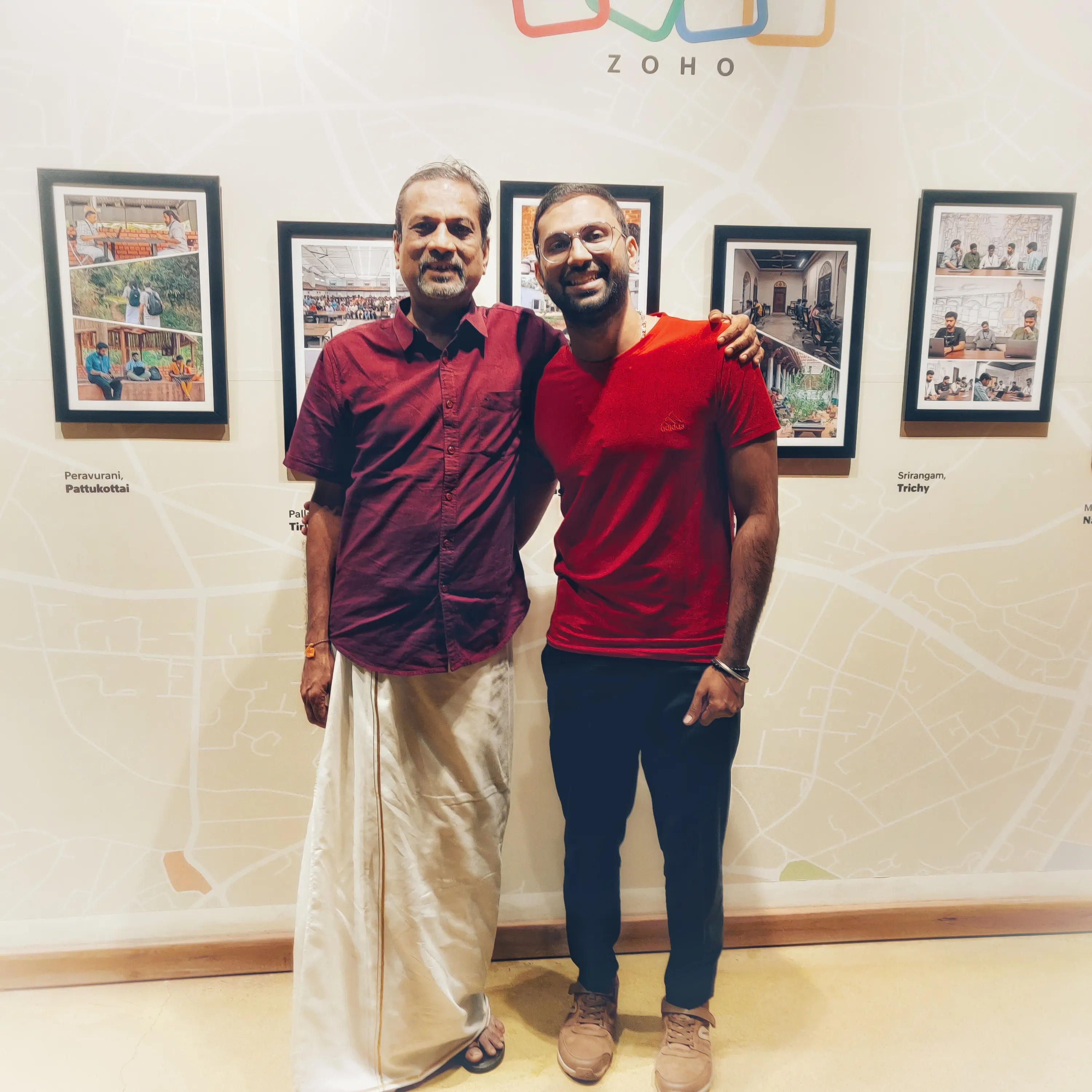
As he was about to leave, I asked, “Can I have a picture with you?”
He said yes. We walked to the lobby and I handed my phone to the guard. Before the photo, he removed his ID card and asked me to take off my visitor’s badge too.
I looked at him. “Anna, can I hold you tightly?”
He smiled. “Of course, you can.”
He put his arm around my shoulders and we took the picture. As we walked to the gate, he personally opened the doors for me. I touched his feet and walked away.
What I Took Away
I never thought I could do something like this.
It was a test of ego—how much of my self-pride was I willing to let go of to learn from someone I deeply admire? To become successful, you do whatever it takes. And sometimes these experiences reveal whether you actually want the thing in the first place. If the answer is a hell yes, only then will you do what’s required.
Most people say they can’t. In hindsight, it’s usually not that they can’t—it’s that they don’t want it badly enough to sacrifice their pride.
There are a lot of good people who genuinely want to help, but they’re extremely selective. They’re not bad. Many of them once offered advice freely, watched it get ignored, got frustrated, and shut their doors. But if you have the courage to knock, kick, and break that door open, they’re more than happy to help.
You have to earn the right to be helped by wise people.
This happened months ago, and I deliberately didn’t write about it the next day. I wanted to see whether the advice would hold once the adrenaline wore off—whether “go after the boring problem” and “founder discipline over ambition” would still make sense when I was back to the grind. It has. Part of the delay was just being heads-down building, and part of it was that some experiences feel too personal to publish right away. I’m finally putting it out in the open because it’s worth more to someone else than it is sitting in my notes.
If you’re a visionary, be ready to suffer. But spend your time with people who understand the context and appreciate you. Don’t waste energy convincing everyone. Not everyone will get it—and that’s okay.